In this guide
Measure the object you actually travel with
Use your phone with its normal case, ring or attached wallet. Measure its longest and widest points, then note the thickness. A bare-phone specification is not useful if your case adds a bulky corner or a card holder. For a passport, include any cover you intend to carry and avoid assuming a document from every country has identical dimensions.
Make a flat paper outline if you are comparing pocket measurements online, but remember that paper cannot reproduce thickness or weight. It is a screening aid. The final check should use the real object gently, without bending a passport or forcing a device past a zipper.
Distinguish opening size from usable pocket space
The pocket opening is the first constraint. A phone may need to enter at an angle, which can be difficult while the pants are on. The pocket bag is the second constraint: seams, curves and internal dividers can reduce usable space. A listed pocket depth alone does not prove the item will fit.
When measurements are unavailable, ask for the opening width and usable depth, or a clear demonstration with an item of known dimensions. Do not scale a product photograph as if every image were taken straight on. Perspective and fabric drape make that an unreliable measuring method.
Use travel pants with zipper pockets as a starting list when closure matters, then check usable dimensions with your own object.
| Check | Pass condition | Common hidden problem |
|---|---|---|
| Entry | Item goes in without forcing | Zipper opening shorter than pocket width |
| Depth | Item sits fully below the closure | Curved bottom reduces space at corners |
| Closure | Zip closes freely above item | Phone pushes against the zipper path |
| Movement | Sitting does not lever item upward | Pocket crosses hip or knee fold |
| Access | You can retrieve it deliberately | Opening becomes hard to reach in a seat |
Test with the pants on
An empty pair on a table can accommodate more than it can while fitted around a thigh. Put the pants on, insert the object, close the pocket and walk. Sit in a normal chair and lean forward. Look for the phone digging into the hip, the document bending, or the pocket pulling the waistband downward.
For side cargo pockets, check the position in relation to your knee. A deep pocket that rests across the bend can be awkward despite having ample volume. For back pockets, decide whether you are willing to remove the item before sitting. Comfortable standing storage is not necessarily useful storage during transport.
Access is the final check
Try opening the pocket with the hand you normally use while the other hand holds a bag strap. You should not need to wrench the fabric or sharply twist your body. If the closure is concealed, learn its position at home so you are not repeatedly searching for it at a station or checkout.
Try it again with the other items you intend to carry. Keep keys away from an unprotected screen or document, and check that one pocket does not pull the pants sideways. If an otherwise comfortable pair cannot carry one essential item, you may prefer a different place for that item.
A successful fit check establishes capacity and access. It does not establish theft protection; the zipper versus hidden-pocket comparison explains those features. For documents, also consider the limitations of passport pockets.
Models relevant to this guide
We may earn a commission from purchases through links on this page, at no extra cost to you. How our links work.

SCOTTeVEST Men’s Covert Cargo Chino Pants
Consider this family when cargo-chino styling appeals to you and you want to compare its actual appearance and storage layout with a more overt cargo pant.
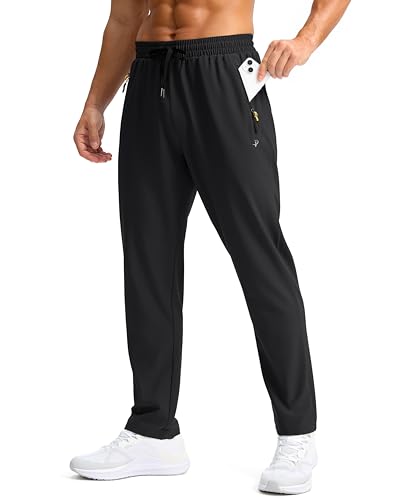
Pudolla Lightweight Quick-Dry Cargo Hiking Pants
Shortlist these when your itinerary includes walking and outdoor stops, and you want cargo storage with explicitly listed zipper pockets in one pair.
Questions before you choose
Will a passport fit in any travel-pants zipper pocket?
No. Pocket opening, usable depth, document dimensions and any holder all matter. Test the actual combination and make sure the closure works without bending or squeezing it.
Are deep pockets always better?
They offer more potential space, but can place an object too low for comfortable sitting or retrieval. Depth and pocket location need to work together.